Portrait of a young boy as a troublemaker
Yesterday I had the privilege of being invited to my friend’s husband’s dedicated strawberry research farm lot at Cal Poly to pick strawberries with my kids.
It had just rained three days prior; so many of the berries were lightly moist, and ripe. They felt warm and plump in the hand with none of that grocery store rubberiness. A vividly sweet fragrance swirled around us, punctuated by the sharp tang of manure. Cyclists and joggers whizzed by on the road. “Strawberry fields forever...” someone on a bike sang out.
Baby stepped in some algal puddles with his leather moccasins, repeatedly pulled up every single plastic identification sign in his path (there were several dozens in that little one-acre plot), and wailed in my arms because he was sweaty and grumpy about not being allowed to climb all over the crops and the empty trailer that had been off to the side.
Toddler refused to touch the strawberries, despite it easily being one of his favorite foods. He was content to observe the bees and the nearby tractors and bright orange wind socks, and throw around clumps of dirt, and ask a gazillion questions about the port-a-potty.
My friend’s son, in between the ages of my baby and my toddler, picked strawberries with his parents the whole time. And flowers. He’s going through a flower phase.
That I was there struggling to rein in my little rambunctious savages, next to a genuinely civilized kid, feels like an understatement.
My husband, who was at that moment enjoying a simple yet rare mountain bike ride, would have enjoyed the picking, I think. But I told him to take the morning off. Socializing drains him in a way that exercise never could.
I’ve recently started therapy.
It’s a bit overdue.
At some point, I had been explicitly afraid that being in therapy would necessarily kill off my desire to write.
There is some truth in that, I think.
In my writing, I feel the need to build in an allowance for distraction, an alternative space that isn’t ‘proper’ writing. For example, I can’t not have an open note alongside the real draft I’m working on. It’s just a dumping place, a repository for shitty sentences that I’ve cut but want to save someplace so I don’t repeat them. Digressions, tangents. An endless inner monologue about how terrible my draft is. A pressure-free place to vent. Because most of the visceral process of writing is wishing that you could be doing anything else, instead. (Hardly an original thought.)
When I’m not working on a piece, I’m just collecting fragmented thoughts in a notebook. Pretty much everything goes in there: scenes of toddler and baby’s infuriatingly violent fights, ponderings about the autotelic personality, my husband’s old mentions about past coworkers and France, snippets of hearsay at the park, disjointed reflections on my readings, random childhood memories that pop up whenever the kids do something funny, what the neighbor’s mom said to me at their baby birthday party last weekend. There is no goal, or so I try to remind myself. There are no line breaks. No ‘publish’ button, no version control.
There is no story to tell.
There is no focus on the words, even.
It is simply life transpiring, incidentally, chaotically, absolutely not according to plan. It is a mentally constructed place for me to open my eyes to the things I don’t wish to see.
It is a place that feels like I have free space to roam, to forget about structure and interestingness and what people expect me to say, think, feel. In this way it feels like being heard, unconditionally.
Lately, that notebook has been bursting with words. My hand has begun cramping again; I refill my pen once a week. I need to buy some new notebooks.
My husband used to (dismissively) refer to this practice as “blackening the pages”.
Often, emails also provide a reliable distraction. I savor the days in between receiving a missive and sitting down to draft my reply. I like to collect fresh anecdotes in the in-between. It’s what makes the writing process a tad magical. Old emails to friends are often more fun to reread than my old journals, because I put so much effort into them, and they become a rather concise (relatively speaking) snapshot of a specific time and place that isn’t available elsewhere.
When I’m composing ‘proper’ things, I probably draft just about 80% of a piece all in one go. (Even if it’s not in one sitting, it’s in one go. I might claim to go to sleep, but I don’t, not really. Long pieces have proven to be a problem.) It’s the closest thing to coherence and consistency I can attempt. I can’t imagine anything else, for my process, anyway. Nicolas’ friend Robbie once described something similar as his writing process, too, so that’s been comforting for me to hear.
Old unfinished drafts, that is, proper drafts that were once upon a time intended to be a piece, they’re so stale I can’t bear to look at them. I hate the thought of a half-assed draft going straight to the graveyard. So if I have an idea, I don’t sit down to write it until I think I can just about get to that 80%.
This is a horrible system with round-the-clock childcare to factor in.
For the first time in my life, I feel like I’m genuinely excited about rereading. Old journals, letters. Books I read in adolescence, in postpartum when I had just half my brain but robotically clicked through the pages because I desperately wanted to be somewhere else.
In many ways, I feel like I’m leaning in to ‘rereading’ people now, too. People who have been in my life for decades, or people I’m reencountering again. My brain has changed. My need for people in my life has changed. I’m trying to look at it all with fresh eyes.
Maybe this is part of wanting to write, again.
The impossibility of writing deeply about a marriage while living inside it.
This has been on my mind.
One can ostensibly write about anything. But a complex, living thing that’s evolving, minute by minute, week by week?
I look at the list of female authors I really admire, and I read up on their biographical details, and I’m honestly shocked at how many of them have separated. Is that what it takes, to truly have a chance to write earnestly about their inner and family lives?
My husband writes about me all the time, some of it quite funny. I don’t mind it at all because most of it is so generic that a fortune teller could have written it.
Since having children, my world has dramatically shrunk. And not just because of being around kids all day. I quit my job at the beginning of my first pregnancy; we had already moved twice by the time my first son was a little over one.
The only constant adult face-to-face presence in my life, for at least the past four years, has been my husband.
A constancy that fills me with gratitude. And pain. And laughter and pettiness and sometimes just plain dude, what-the-fuck?.
Back at home after the strawberry picking, I parse through my haul. Almost all of the berries are terrifically ripe, and need to be eaten more or less immediately. Still, while I’m washing them, I notice the variation in color in what I’ve picked.
“I had my sunglasses on, so I guess I really wasn’t that consistent with my picking,” I tell my husband.
“Yeah, plus with your shitty eyesight,” he adds.
“I’m nearsighted, not struggling to distinguish color...”
My parents both got their first glasses with thick, heavy lenses when they were in middle school. They need bifocals, at their current age. My husband, on the other hand, has perfect vision.
“My vision tanks at night, but in the daytime it’s still decent! Especially considering I’m legally blind in one eye, but the other eye is fine.” I’m defensive now, suddenly feeling the need to clarify that no, my visual impairment does not affect my ability to assess strawberry ripeness. Or just about any other daytime activity.
“What?” he says, confused. “Wait, really?”
“Yeah, that’s why I’m required to wear glasses when I drive. Because the DMV tests each eye separately, and I can’t pass the test with my right eye.” Naturally, I’ve told this all to him many times before.
“How bad is it? Like which row can you not see?”
“I don’t remember. The second or third, I think.”
“Oh god,” he says. “You’re definitely gonna go blind. Like not even cataracts or anything ––“
“My grandfather has cataracts actually ––“
“But like, the degeneration.”
“Hmm.”
I consider the prospect.
I think about the genetic lottery my kids may have gotten.
I ponder the little thrill I’ve had lately from dipping back into a tiny bit of drawing again.
“Drawing makes me happy,” I said to my husband the other night, after finishing a simple sketch for a greeting card.
“Good. You should do it more.”
It was delivered with such curt, logical authority. A call to action I couldn’t say no to.
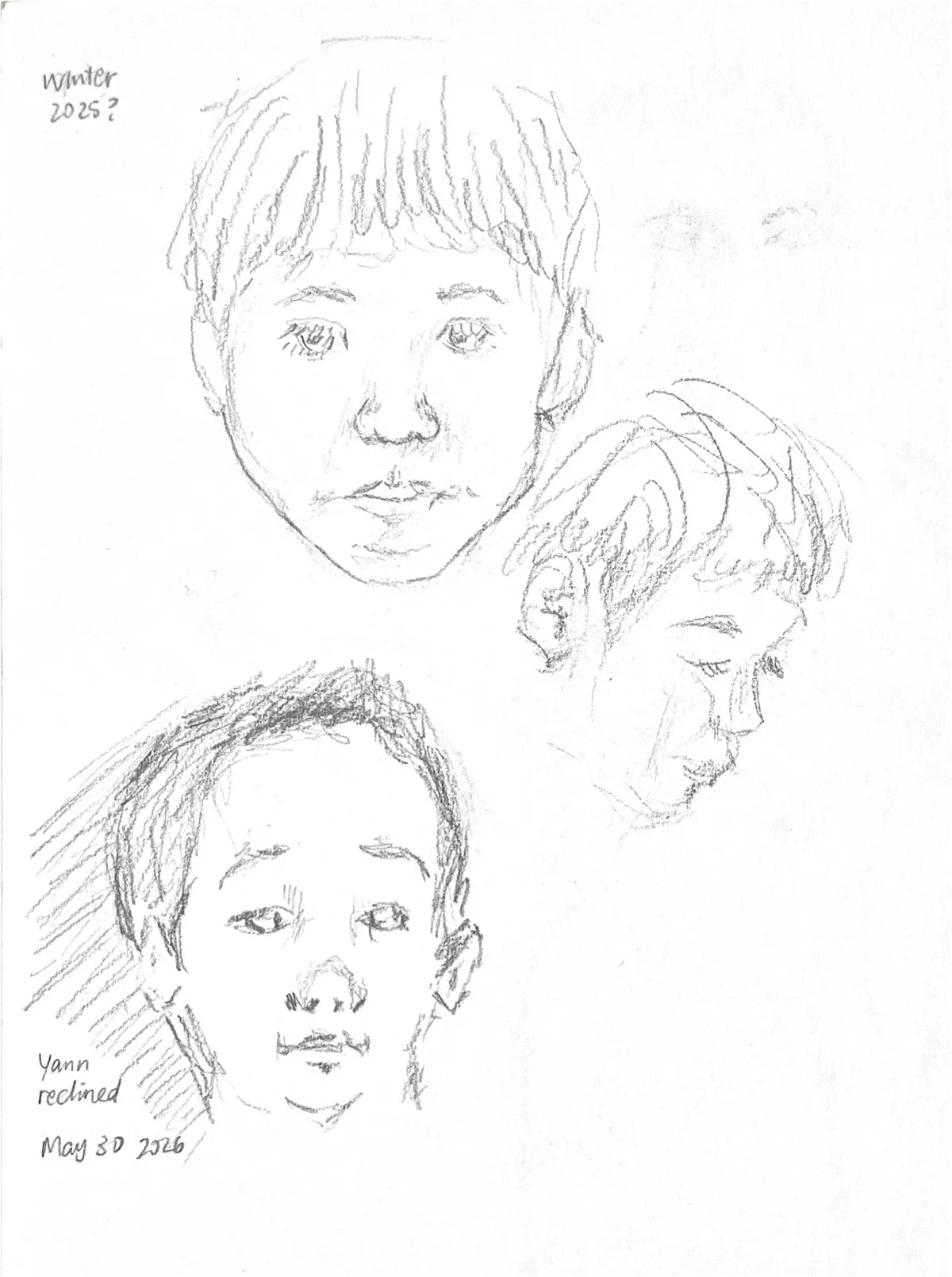
Immediately I dug through the pantry for an old sketchbook and flipped to the last page I had worked on. I commanded my toddler, who was at that moment rolling around on the ground under the rower (the boys like to poke their fingers into the little hole under the machine, where the damn chain is exposed) to hold still.
I tried to remember how to hold a pencil, again, loose in the hand. Like a stub, not a point. I tried to remember how to see, with my eyes, not my brain. In an instant I felt transported back to figure drawing nights at Kroeber during college, to Sunday afternoons spent sketching and discussing art at the Oakland blue bottle with seasoned artists, to the florescent glare and torn plastic-y seafoam green seats of BART when I used to attempt hasty portraits of unsuspecting passengers during my daily commute.
In two minutes (and after much pleading for my twitchy subject to hold still) I had a passable portrait of a reclining kid, foreshortening and all. My toddler begged to see, and told me he liked it. It wasn’t a dead ringer for a my kid, and the head/hair is wonky, but I know I’m rusty. Still. It was a drawing that made me happy.
It was a drawing that reminded me how short life is.
Life is short.
So cram art into every damn second of it.